Competitive Frameworks
Date Published
Last Updated
How to monitor competitor pricing pages automatically (before they announce them)
Pricing changes rarely appear on the pricing page first. Here's how to catch competitor pricing signals.
Most teams find out about a competitor's pricing change the same way their customers do – from a notification email, a Reddit thread, or a sales call where a prospect mentions it. By then it's too late to respond strategically. You're reacting, not positioning.
The problem isn't that pricing changes are hard to find. It's that teams are looking in the wrong place – the pricing page – when the buying signals appeared weeks or months earlier, scattered across a dozen other surfaces nobody was watching.

The pricing page is a lagging indicator – except when it isn't
For strategic pricing changes – tier restructures, new packaging, AI bundling decisions, enterprise model shifts – the pricing page is almost always the last thing to change. The decision gets made, the product gets updated to justify it, sales gets briefed, legal reviews the terms, and only then does someone update the public-facing price. By the time the page reflects the new reality, the strategy was set months ago.
There's an important exception. Growth-stage SaaS companies often treat their pricing page as an active testing surface – running A/B experiments on price anchoring, trialling new packaging structures, reacting to conversion data in near real-time. A pricing page that changes frequently isn't noise. It's a signal that the company is in active price discovery. They haven't found their model yet, or they're responding to competitive pressure faster than their comms team can keep up.
Both patterns are worth watching. The volatile pricing page tells you a competitor is uncertain or experimenting. The static pricing page that suddenly changes after 18 months of silence tells you a strategic decision was made and executed. The difference matters for how you respond.
Where pricing signals actually appear first
Regardless of which pattern your competitor follows, the meaningful signals appear well before the pricing page moves. Here's where to look, roughly in the order they tend to appear.
Product updates come first. Companies rarely raise prices without adding value they can point to. Watch for product launch announcements, feature releases, and changelog updates – these often precede pricing moves by four to eight weeks. When a competitor ships a significant capability expansion, put pricing on your watch list.
Job descriptions shift next. A company quietly hiring a "Pricing Strategy Manager," "Head of Revenue Operations," or "Monetisation Lead" is signalling internal work on commercial restructuring. This is one of the most reliable leading indicators – it's visible, searchable, and almost nobody is watching it systematically. (Job posting patterns are one of the six event-based buying signals that reliably precede strategic moves.)
Help documentation and feature access pages restructure before the pricing page. When a company is planning to move a feature up a tier or introduce an AI add-on, the support documentation reflecting which features belong to which tier often gets updated first. It's unglamorous enough that most teams never read it, which is exactly why it's valuable.
Terms of service and fair use clauses change quietly. Usage limits, API rate limits, data retention policies, and fair use definitions often get updated in the legal or help documentation before the commercial pricing is restructured. These changes are rarely announced.
Social and executive signals consolidate in the final stretch. In the weeks before a pricing announcement, clusters of signals often appear together – a VP of Product posting vaguely about "rethinking value delivery," new enterprise-tier case studies appearing, SDR job postings mentioning a new customer segment. Individually these mean nothing. As a cluster appearing within a short window, they suggest a coordinated rollout is being prepared. Recognising these clusters is part of learning to identify intent signals – the difference between isolated noise and a pattern worth acting on.

What happens when companies get it right – and wrong
Clay's March 2026 pricing and packaging update is a useful case study in how pricing changes can go sideways even with genuine transparency. Clay introduced significant packaging changes alongside a pricing restructure, but the two stories collided publicly. The packaging update – which added real value for many users – was almost entirely buried by the conversation about price increases (and decreases). Customers who felt the biggest impact expressed churn intent openly, despite Clay's candid communication approach. The lesson isn't that transparency failed. It's that pricing and packaging changes trigger separate emotional responses in customers, and announcing them simultaneously makes it nearly impossible to control the narrative around either one.
The competitors watching Clay during that period had an advantage most didn't use: a live map of which customer segments were most agitated, what the actual objections were, and where switching intent was highest. That's not just intelligence – it's a pipeline opportunity with a short window. Teams running structured win-loss analysis would have been best positioned to act – they already knew which buyer objections predicted churn.
Slack's June 2025 update is a cleaner example of pricing architecture done deliberately. The headline was that Slack AI was getting cheaper – the Pro with Slack AI add-on dropped from £13.75 to £5.75 per person per month annually, appearing to match the price of a standalone Pro subscription. But that framing misses what actually happened structurally. By pricing the AI tier identically to Pro, Slack made Pro the decoy – a customer choosing between "Pro at £5.75" and "Pro with AI at £5.75" will choose the AI tier every time. Slack didn't discount AI. They repositioned their entire mid-market tier to drive AI adoption, while Business+ absorbed a 23% price increase with considerably less public attention.
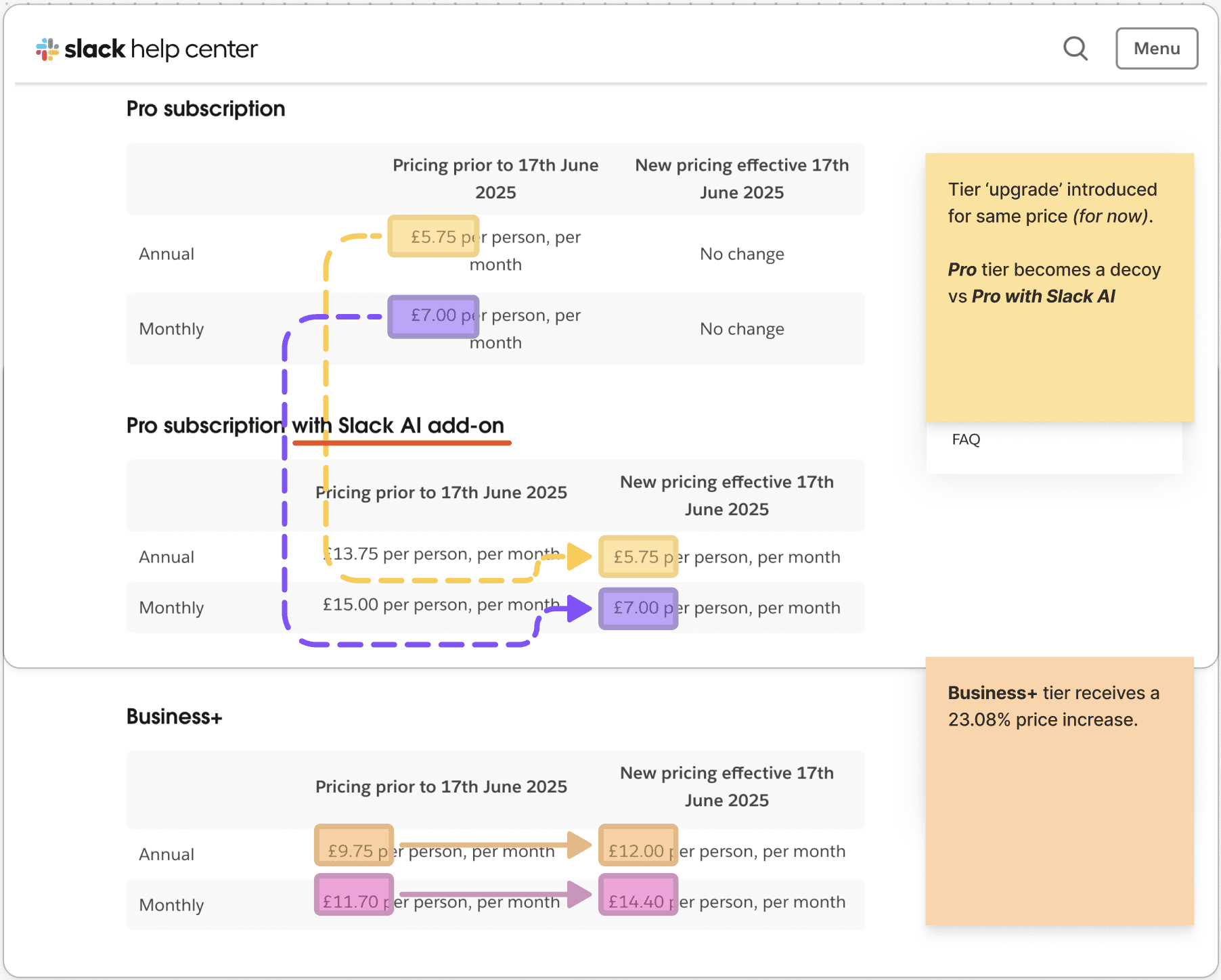
Slack's June 2025 update: Pro becomes the decoy, AI tier prices drop to match it, Business+ quietly absorbs a 23% increase. The help documentation restructuring AI feature access by tier appeared weeks before the June 17th effective date.
The signals that this was coming were visible in Slack's help documentation before any pricing page changed. AI feature availability had been restructured by subscription tier in the support articles ahead of the June 17th effective date. Teams watching that layer would have seen the tier architecture taking shape before it was announced anywhere.
The gap between knowing and acting
Understanding what to look for is only half the problem. The harder half is doing it consistently across all your key competitors, continuously, without it becoming someone's full-time job.
Manually checking a competitor's documentation, job board, changelog, and terms of service once a quarter is better than nothing. But strategic pricing decisions don't wait for your quarterly review. The Clay and Slack examples both moved on their own timeline, with signals appearing weeks earlier for anyone who happened to be watching the right surfaces at the right time.
The real advantage isn't knowing that these signals exist – it's having a system that catches them automatically, filters the noise, and surfaces the ones that indicate a coordinated move rather than a routine edit. This is the core argument for competitor monitoring as infrastructure rather than a quarterly task.
A team that spots a competitor's pricing restructure three weeks before announcement has time to brief sales with objection-handling frameworks, accelerate deals with prospects evaluating both products, and update their own positioning before the competitor's narrative takes hold. That's the difference between a proactive and reactive strategy – and it compounds every time a competitor makes a move. A team that finds out the same day the email goes out has none of those options.
The signals were public in both cases. The difference was whether anyone was watching.
Zimt monitors pricing signals, documentation changes, job postings, and help article restructures across your key competitors and target customers automatically – and tells you what the cluster means, not just that something changed. [See how it works →]


